
1. Why demos mislead leadership
Demos run on clean samples, friendly Wi-Fi, and a prepared script. Production runs on missing fields, partial outages, angry customers, and month-end pressure.
The pattern is familiar enough to name without needing a statistic: early excitement, a few edge cases nobody scoped, then quiet abandonment once it becomes clear that no one trusts the output enough to stop double-checking it. The rework never left; it just moved.
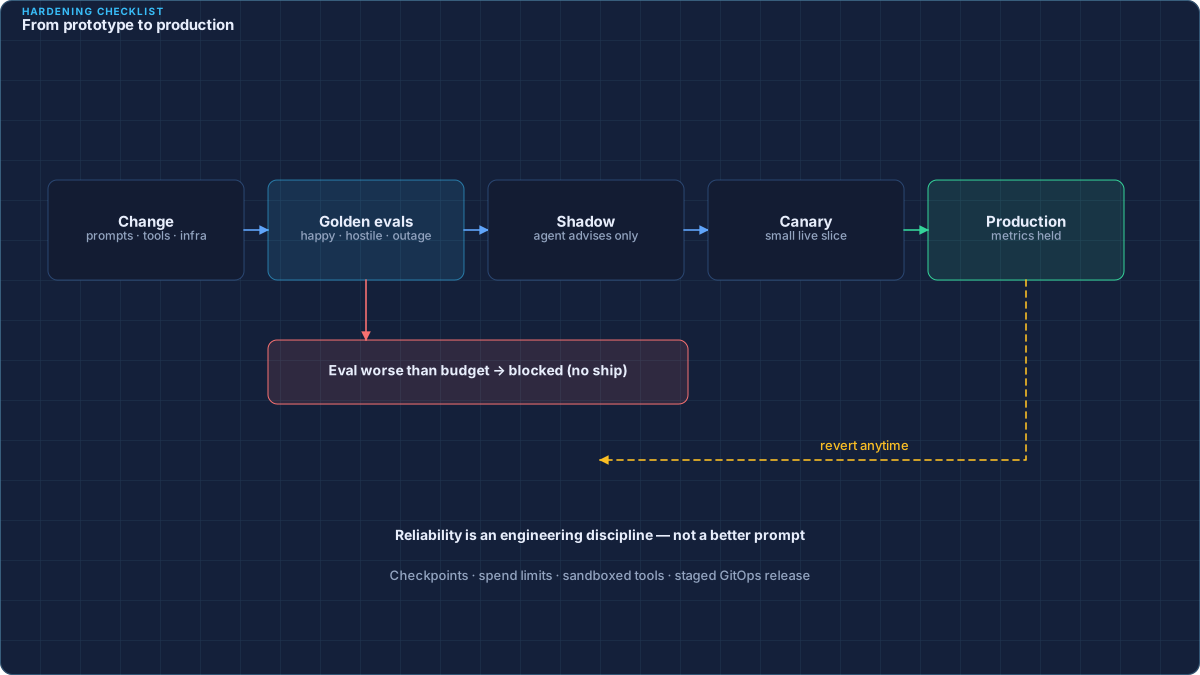
The fix is not “a better prompt.” The fix is the same discipline that keeps payments and logistics systems alive: testing, limits, monitoring, and staged rollout.
2. The reliability mindset
Treat an agent like a small production service:
- It can fail — and must fail safely.
- It has a budget (money for model calls, time for users waiting).
- It needs logs that a human can read after the fact.
- It must be versioned so a bad change can be rolled back.
3. Hardening checklist (plain English)
- Clean the inputs. Strip junk characters; require required fields; reject bad formats early.
- Save progress (checkpoints). If step 3 of 6 fails, resume at step 3 — not step 1.
- Limit spend. Cap how many model tokens a user or process can burn per minute.
- Sandbox tools. Agents only call approved functions with tight permissions.
- Rate-limit partners. Back off politely when a vendor API says “slow down.”
- Protect secrets. API keys never live in prompts or chat logs.
- Human gates for high risk. Money movement, customer-facing messages, and bulk deletes need approval.
4. Testing like you mean it
Create a golden set: a library of real-ish examples with the expected outcome. Include the ugly cases on purpose.
- Happy paths (everything matches).
- Near misses (small price variance).
- Hostile inputs (prompt injection attempts, nonsense text).
- Partial outages (downstream system unavailable).
Run this set automatically on every proposed change — just like software teams run unit tests. If accuracy, latency, or cost get worse beyond agreed limits, the change does not ship.
5. Shipping with GitOps & guardrails
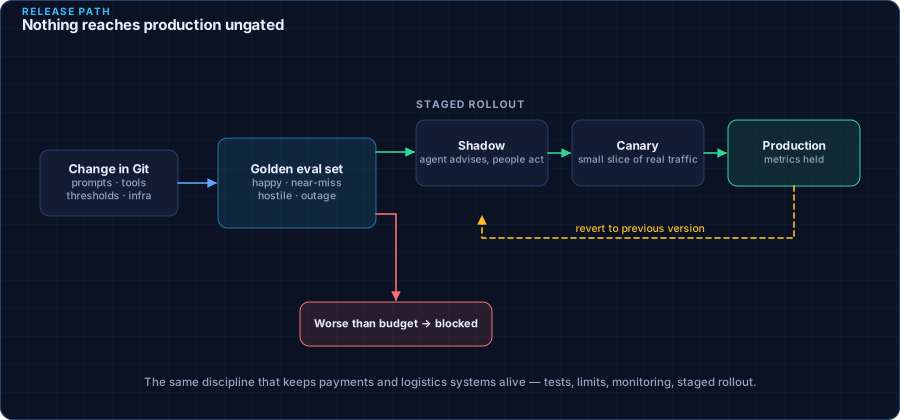
GitOps means: the desired system state lives in version control, and automation applies it. For agents, that includes prompts, tool configs, thresholds, and infrastructure.
A sane release path:
- Dev — free to experiment.
- Staging — golden tests + shadow traffic (agent recommends; humans still act).
- Canary — small slice of real traffic.
- Full production — only after metrics hold.
Cloudadorn often delivers this on Kubernetes with Terraform and GitOps (Argo CD or Flux) so environments stay repeatable across AWS, GCP, or Azure — the same platform path used for microservices, not an AI-only side channel.
6. What to measure every week
| Metric | Why it matters | Healthy signal |
|---|---|---|
| Cycle time | Business speed | Downward trend for the workflow |
| Human escalation rate | Trust & automation quality | Stable or falling without quality loss |
| False auto-approvals | Risk | Near zero for money-impacting steps |
| Cost per successful run | Unit economics | Predictable, within budget |
| P95 latency | User patience | Within the agreed SLO for interactive steps |
7. Executive FAQ
Will AI replace my team?
In practice, good agents remove drudgery so specialists spend time on judgment, customer relationships, and exceptions that matter.
How do we stay compliant?
Log decisions, keep humans on high-risk actions, and store audit data in systems your compliance team already understands.
How long until value?
A focused workflow can show shadow-mode results in weeks. Full automation with approvals typically follows once error rates are boringly low.
What does Cloudadorn do differently?
We embed engineers (FDE pods), ship production code, and teach your team the same patterns — so the system is not a black box from a vendor demo.